

Our Veterans, Our Stories Podcast
Col. (Ret.) Sue Ann Sandusky, a 37-year United States Army Veteran
Our Veterans, Our Stories, we’re here with Colonel Retired Sue Ann Sandusky. I was very excited to meet you while also a little sad that I was just meeting you to find out that you had been here for over 10 years. And, you know, I think about the courage that it takes for you to come onto a podcast knowing that you’re going through this diagnosis with Parkinson’s and I am so grateful to you for coming and sharing your story today, because you have such an incredible story from your time in the military, and we’re just honored to have you here with us.
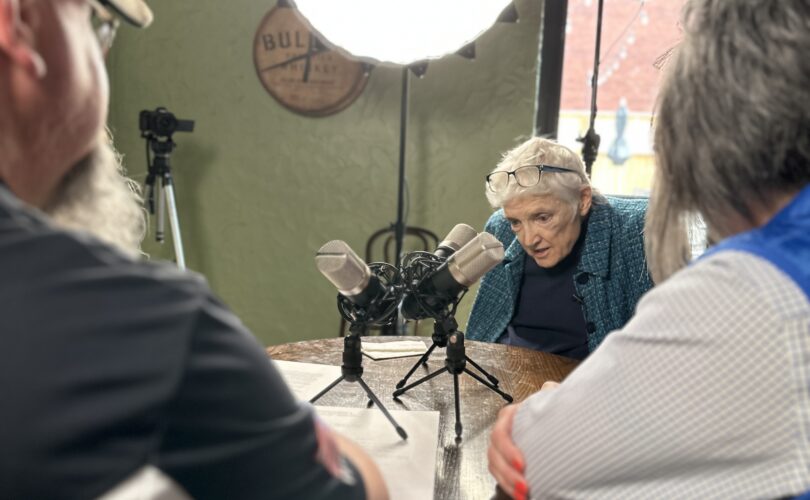
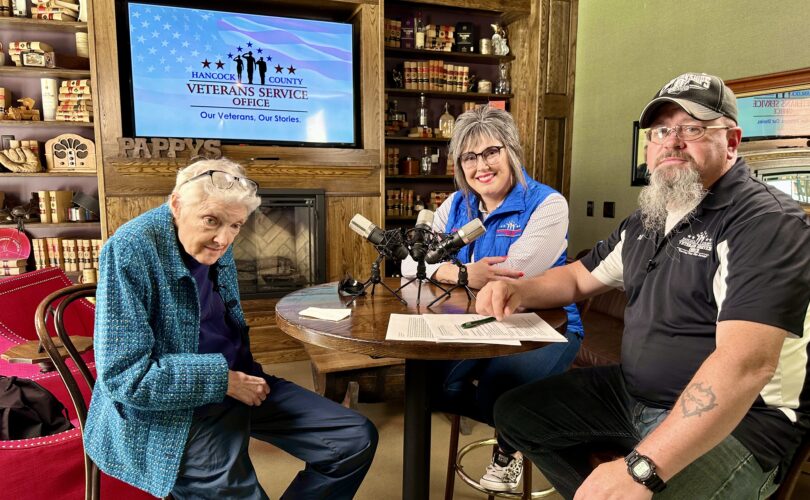
0:00:00
(Speaker 3)
Welcome to the Our Veterans, Our Stories podcast with the Hancock County Veterans Service Office. This is where we give our local veterans an opportunity to share their stories with our community and beyond. There is a real brotherhood among all vets and it will be great to help others to know their stories about serving our country. And it gives us an opportunity to introduce the community to our team at the Hancock County Veterans Service Office so people can learn a little bit more about what we do and how we can help.
0:00:26
(Speaker 2)
So we’re here with Colonel Retired Sue Ann Sandusky and I am so excited to have you here on our podcast. This is Our Veterans Our Stories podcast by our office and you know you moved back to Hancock County about nine months after I became the director of the office and I was very excited to meet you while also a little sad that I was just meeting you to find out that you had been here for over 10 years. And, you know, I think about the courage that it takes for you to come onto a podcast knowing that you’re going through this diagnosis with Parkinson’s and I am so grateful to you for coming and sharing your story today, because you have such an incredible story from your time in the military, and we’re just honored to have you here with us.
0:01:27
(Speaker 1)
Thanks a lot, Nicole. I’m happy to help you spread the word about the good work that the VSO office is doing, you personally and your other team members. It’s a great service, the great services that you provide. I don’t feel all that special, but I’m happy to talk to people about Parkinson’s too. I know it’s one of the key things they say about Parkinson’s disease is every person experiences it differently. And I have been diagnosed, formally diagnosed, since February of 2022. But it was kind of, I guess, creeping up on me for maybe a little while before that. The first thing I noticed was my hand didn’t work right, my right hand. My handwriting kind of went all to pot. I was worried in the 2020 presidential election that the board of elections would reject me because my handwriting was so bad. But they didn’t, so that’s good, but my handwriting is still terrible so we had the VA Hospital in Ann Arbor ran various tests to see you know as a defense nerve what’s going on? You know I can’t you move your hand, right? so then I got a neurologist consult here in Finley and He said well good news, I’m going to give you some medicine, if it works, you probably got Parkinson’s, if it doesn’t work, you probably don’t. So he gave it to me, I took it, I felt a little bit of an improvement, so I have Parkinson’s. But as things go, I had been looking forward to my 70s as a golden era of fun adventures but now it’s learning the new experiences of a disabled person I guess. Just keep your eyes open and realize those little handicapped things at the door that you push, those are very valuable things. And the blue placards for your cars and people trying to be independent and maintaining some kind of dignity when they know that they’re basket cases. But yeah, and so it’s good to get that message out there for people to say, look at me, I don’t want you to look at me, but I’d rather be interacting with you than not.
0:04:00
(Speaker 2)
So thank you for inviting me. Thank you so much for your courage to come with the diagnosis and thank you so much for your 37 years in the United States Army. It’s just incredible. Sue, when I met you, it was so exciting to hear about your military career and I was blown away when I went and Googled you and read some more about your time in the military. You were in the Army for 37 years and as I told you the first time I met you, thank you for blazing the way for women after you. And so can you tell us about why you joined the Army? Let’s start there.
0:04:50
(Speaker 1)
Well, thanks, Nicole. You’re very generous with all that, all those comments. It was my pleasure to meet you because I’d heard of you. You work with veterans’ organizations and to hear your service stories, it was really great, too. in the military kind of in a strange way, and it had to do with Findlay. I graduated from Findlay High School in 1970, and I went to Texas Christian University in Fort Worth, Texas. And at TCU, I went out for the rifle team? Because when I was here in Findlay, I shot on the Findlay Junior Rifle Team, which was a club team. I didn’t really have any skills, but I had an interest in shooting. And so I went to TCU, I shot, I became a good shooter. This was all mental. There’s really no talent for shooting, you just have to work hard. And at the end of my time at TCU, I had been an All-American three times at TCU, and then I was recruited by the various service shooting teams, and the one that gave me the best deal, the biggest bang for your buck, if you would say, was the Army Reserve. So I enlisted in the Army Reserve in 1975, a year after I graduated. I enlisted and served in the Army Reserve for seven and a half years before going on active duty. And in that seven and a half years, I shot for the Army Reserve International Rifle Team all the time. Eventually I was commissioned in the Army Reserve. Eventually I moved to New York. I was encouraged to get a commission. I went up to West Point to referee a rifle match one time, still in the reserves, referee a rifle match. I saw this officer who was, he said he was in the Department of Social Sciences where I taught political science. And I got to be the officer representative to the rifle team. I had a wonderful four and a half years at West Point and thought, oh, this will be the end of my active duty. opportunities came up and 30 years later, 30 plus years later, there I am. Yeah.
0:07:41
(Speaker 2)
So tell us about when you, the big awards that you earned in the shooting competitions. Oh, well, I was very fortunate.
0:07:52
(Speaker 1)
I got to shoot in the 1977 Championships of the Americas in Mexico City, I won three gold medals, two team and one individual gold medal. Individual gold medal in standard rifle prone, not my favorite event, but so be it. And then in 1978, the world championships, I shot the same events and won the same three medals. medals and those championships were in Seoul, Korea. It was a little bit of a tainted victory because the Soviet Union boycotted this as a period of sports boycotts. So it was a little tit-for-tat. In 78 they boycotted world championships which were held in Seoul, Korea. And in 1980 we boycotted the Olympics for their invasion of Afghanistan. In 1984 they boycotted us because the games were in Los Angeles. So it’s a little politicization of the Olympic Games there. But I was happy to at least in a diminished field still won my gold medals for world championship.
0:09:12
(Speaker 2)
And you should be very proud of that. That’s amazing.
0:09:15
(Speaker 3)
Yeah. Sue, I was also in the Army, and there was a tab out there that I’d only seen very few times in my career. It was the President’s 100 tab, and you earned that tab.
0:09:28
(Speaker 1)
Yep. So after my international shooting career was kind of finished in 1984, I shot in the US trials for the Olympic team, like I had done for several other Olympic cycles. And I shot pretty well, shot exactly what I had anticipated would be required to win. However, when we got me a tie, and we had a big, we had a five-way tie at the end for two places on a team, and I lost the shoot-off. off. And so then I said, well, see, I was still assigned at West Point. I was still teaching at West Point, which was very, very gratifying. But I said, well, let me kind of refocus a little bit on my shooting. And so I decided, well, if I’m going to be in the Army, I better do these service rifle things. Because I was an international shooter with the Olympics. So I shot service rifle this summer, my two remaining summers, I guess, at West Point. In 1987, I left West Point, my assignment was over, and I spent the summer TDY with the Army Marksmanship Unit, and I earned, finished my Distinguished Badge for Rifle, Service Rifle, and President’s 100 Tab. And I’d like to say I also won the inter-service national championship for standing at Quantico that summer.
0:10:53
(Speaker 4)
Wow.
0:10:54
(Speaker 1)
Anyway.
0:10:55
(Speaker 3)
Nothing short of amazing, I’ll tell you.
0:10:58
(Speaker 2)
That is for sure. So tell us about the last assignment that you had when you were getting ready to retire from the Army. I found it to be very fascinating.
0:11:11
(Speaker 1)
I had a very, I just had a very fortunate career. And my next to last assignment was being the commandant of the Defense Language Institute, Foreign Language Center, and the commander of the Presidio of Monterey, California. Heaven on earth, really. And it was a wonderful assignment. And so, but, you know, all good things end. So at the end of assignments, you start hunting around for what’s going to be your next assignment. I volunteered to go to Afghanistan, but they sent me back to Africa, where I had been a defense attache for many years in different countries. And I went back to Liberia. I say back to Liberia because I had originally been assigned to Liberia. I went back to Liberia in 2003 during the siege of Monrovia and some rebel activities at the end of the Civil War in Liberia in 2003. I served for another five months there. And then, so it wasn’t a surprise to me that I was being sent back to Liberia, but in 2010, I went back to Liberia for my last assignment, from 2010 to 2012. And so I was again the defense attache and so-called senior defense official, which means you’re the senior military person in the country. And we had a kind of substantial training activity there at the time. So I worked for a wonderful ambassador, Ambassador Linda Thomas-Greenfield. That’s why I wear my glasses on my head because, of course, when I worked for her, I was in the Army, so I had uniform codes to contend with, and I never wore my glasses on my head, but she always wore her glasses on her head. And I thought, that’s pretty cool. She’s now the ambassador to the United Nations. You may see her on the TV. And I wore my glasses on my head because I’m modeling her behavior. I don’t know if she’ll appreciate that, but I loved her. She was a great ambassador.
0:13:36
(Speaker 2)
It’s fantastic how we pick up and we learn things. Sometimes they’re subtle things, sometimes they’re big things that we learn from people that we serve with when we’re in the military
0:13:48
(Speaker 1)
all around the world. So true, yeah, so true. It’s a great way to get beautiful experience, job experience, life experience, friendships.
0:13:59
(Speaker 2)
It’s terrific. Yeah, there’s nothing like the camaraderie that is developed when you serve with people in the military for sure. Can you tell us about a few people that you did make those kinds of deep soul connections with when you served in the military?
0:14:16
(Speaker 1)
I mean, it’s too many people to mention really, basically. I had repetitive attaché assignments. All those assignments were in Africa because I was selected to be what the Army calls a foreign area officer. And the foreign area officer field is pretty small, and especially the people doing Africa work are pretty small. So those are probably my best military comrades, my fellow African feyos.
0:14:57
(Speaker 3)
So Sue, on the DLA, the Defense Language Institute, do you know different languages also?
0:15:06
(Speaker 1)
Well, yes. I’ve always been a language geek. I think some of my earliest books that I bought for myself were language books. In fourth grade I had a French book, like Mary Had a Little Lamb or something. And I bought a book on Navajo languages back in the day. But yeah, I had the great good fortune to attend Defense Language Institute, DLI as we call it, as a student for French when I was selected for the FAO program, Foreign Area Officer program. The typical package for a Foreign Area Officer is language of the region, you get a regional designation, you do the language of the region, graduate school and experience in the region. And I had graduate school already when I joined the Army. It wasn’t Africa-oriented, but it was comparative politics-oriented, and so it served me very well. And my undergraduate degree was in journalism, so all the writing and reporting stuff was a very, very good preparation for what kind of work I did in the Army. But, yeah, so for a foreign area officer, Sub-Saharan Africa, which is what I was, your kind of colonial languages, for lack of a better term, languages of wide popularity, or lots of people speaking them in the countries that you may be assigned are French or Portuguese. You can go to DLI for French or Portuguese. Sometimes African languages too, like Xhosa or Swahili or Amharic or something. So I went to DLI for French. Then of course, this is a typical Army thing. I think a typical service thing, maybe a typical bureaucratic thing. So I go to DLI for French. I’m an African FAO. I get assigned then to Zimbabwe where they speak English. So I’m in Zimbabwe. I use my French a little bit, but that year I traveled around a lot. But then at the end of that tour, the end of my year in Zimbabwe, time for another assignment. So I get on the phone with the assignments officer. So I’m saying I want to stay in Africa. And he said, well, you have to come back to your branch, your basic branch, which was the Adjutant General’s Corps, which is the personnel administration. So I said, okay. He said, but I don’t understand because I’m the AG officer that you said could go off and be a FAO, so why do you want me back now. I said, well, we’ve got this assignment that we think you’d be good at and be the personnel officer in this new headquarters and, well, we need a French speaker. I said, well, okay, well, why do you need a French speaker? He said, because it’s in the French-speaking part of Germany. I said, what? So, just out of curiosity, I took the assignment, but it turned out to be a great assignment. It was the Allied Command Europe Rapid Reaction Corps, the ARRC, which now is in the UK, based in the UK, but at that time was based in Bielefeld, Germany, in the old British sector of West Germany. The ARC, which is a NATO headquarters, was built on this infrastructure of a British headquarters. And they didn’t really need a French speaker, but in the way the Brits write up their job descriptions, there’s always a line for other European language desirable or something like that. So that’s how some other European language desirable became, we need a French speaker. It was a great assignment. We deployed, we got to be the implementation force for the Dayton Peace Agreement in Yugoslavia, former Yugoslavia. So I served in Croatia and in Bosnia, and I was the NATO liaison to the UN for a short while before the whole main body deployed. I was the liaison officer for a month or so. And so it was a very excellent experience, you know, war-torn country up close and personal. I have to say that it was good preparation for my next assignment, which was Liberia, which was in the middle of a civil war. So, you know, it was, even though they were geographically very dissimilar, but some of the problems were much the same.
0:20:05
(Speaker 2)
I find it interesting how we can all have or find something in common with everyone. And when I was reading your bio before I met you the first time, I didn’t have to look very hard to find things in common. So you, first of all, graduated from high school with my mother. Second, you graduated from Texas Christian University. I graduated from Ohio Christian University. You have a background in journalism, which is what I did when I was in the Air Force, and we were both in Bosnia. So I’m curious in all of your travels and all of your experiences in the military, if you can tell us maybe a story about a time where there was a lot of discord and you were able to find something in common to help bring people together. I think that that probably
0:21:04
(Speaker 1)
was a part of what you did when you were in the military. Yeah, I had a lot of kind of political military jobs where I assisted with negotiations one way or another, assisted with peacekeeping, forces deploying. So my most meaningful assignment, I think, was in 2003 when I was assigned my regular assignment. I was in Côte d’Ivoire, Ivory Coast, which is the country just to the east of Liberia. We were without a defense attache temporarily in Liberia, and they were experiencing an upsurge in, an uptick in violence. The civil war had restarted, and there were two rebel groups kind of in a big pincer movement on the capital with one rebel force coming down from Guinea and the other rebel force coming from the, from Cote d’Ivoire, direction of Cote d’Ivoire. And since I’d been assigned to Liberia in 1997-98, I knew many of the players and, you know, I’d been kind of keeping up with it from the perspective of Cote d’Ivoire, the neighboring country, so I was pretty well read into the problem. So anyway, I get to Liberia in July of 2003, immediately became part of a small embassy team with Ambassador John Blaney, our ambassador at the time, who was leading this little band of brothers and sisters trying to get this civil war stopped and trying to get the siege of Monrovia broken and restore the flow of humanitarian assistance. And the key problem was that the Liberian President Charles Taylor had been indicted by the International Criminal Court in Ghana. He fled from the subpoena and went back to Liberia. The problem was to get him out of Liberia. He agreed to a kind of an exile deal in Nigeria, the president of Nigeria intervened and worked that. So he got Taylor out of the way, and then it was a matter of making sure that the rebel forces and the government forces in Liberia would cease fire and let the West African peacekeepers deploy. So we had to negotiate a kind of separation of forces and let this deployment go ahead and humanitarian assistance flowed again and the people didn’t starve to death and they had medical supplies and so forth and so on. So that was very, very meaningful and you know I look back on it and now it’s been, well it’ll be 20 years in August. It just seems like a blink of the eye, but it’s been 20 years of more or less peace in Liberia. I’m gonna have to give a lot of credit to Ambassador Blaney and his leadership on that. But I was very proud to be a part of it.
0:24:53
(Speaker 3)
You bring up a good point, Sue. The average person knows about, you know, your Vietnam, your Desert Storm, your Iraqi freedom, things like that. I don’t think they understand how much the U.S. military plays a role in peacekeeping in other countries and things like that, that shape the world stage for things. And you were very vital in that whole process.
0:25:15
(Speaker 1)
Yeah, well, it was kind of a special historical relationship with Liberia. And if we had not been successful in Liberia, I think our credibility in all of Africa would have been very, very suspect after that. But luckily we were successful. Yeah, especially in the 90s and the early 2000s, Africa, especially West Africa, where I served much of my time, was really in turmoil. And, you know, we forget one of the side benefits of the Cold War umbrella was taken away, boom, all these regional conflicts flared up. And even though they weren’t really over great issues, most of them were just personal power problems, it was lethal for the people who were there, unfortunately, and very destructive for the infrastructure and life. And it took a lot of energy. Credit goes to mixed bag, but I think on balance, positive credit goes to ECOWAS, Economic Community of West African States. States that formed a peacekeeping force. It first went into Liberia and subsequently went into other places. There was very, very much of a strain on those African countries who contributed, and they needed support from the West, from the U.S., from Britain, from France. A model evolved in the 90s of how to work together to conduct peacekeeping missions, stability missions that really the American people, they may not know about them, but they can be proud of them, most of them.
0:27:31
(Speaker 2)
So tell us a little bit about what the Hancock County Veterans Service Office has meant to you since you moved back to Finley about, was it about 10 or 11 years ago?
0:27:43
(Speaker 1)
Yeah, I moved back to Finley in October of 2012. I was on emergency leave. My dad was sick. My brother said, my brother had taken leave. My brother was in the State Department. He’d taken leave from the State Department and had been with my dad for a couple months, my mom and dad. And he said my dad had a bad diagnosis and I should come home if I could. So I was on emergency leave and then I was due to retire at the end of December 2012 anyway, so I just applied for my transition leave and just stayed. And had the great opportunity to help take care of my mom and dad. My dad died in February of 2013, but I had, you know, about four months with him, so that was really wonderful. So what has the Veterans Service Office done for me? Wow. I am very grateful. My first encounter with the Veterans Service Office really was their transportation services, and taking me to appointments in the in Ann Arbor and the VA Outpatient Clinic in Toledo. And this is a marvelous service and wonderful drivers and it’s very simple to arrange and no cost to the veteran and it’s really terrific. So that was the first thing. Then I got to meet you, Nicole, and other people in the office and they’re just wonderful. It’s great to talk to you and you’re right you do feel a little bit at home as a veteran when you go in there and get to interact with people on a basis of trust and you know, I sometimes think here in Finley that not many people understand about military life. And so when you don’t have to explain things all the time, it’s very much of a relief. I went to Bowling Green. I went to BGSU after I retired. When I retired, I came to help take care of my mom and dad, but I said, well, I need to do something else besides just take care of my mom and dad. and so I did a PhD program at BGSU, Higher Education Administration. I had great colleagues, it was wonderful, it was a wonderful experience. And I did my dissertation on student veterans, undergraduate student veterans at BGSU and their persistence to graduation. And that was a very good experience. I did it because the literature, I thought, was written not from a… I thought the perspective was not very knowing about veteran experiences in life and stuff like that. So I tried to give a little insight into what a veteran might be experiencing, what services were available, etc. So I did not use the VSO for any direct guidance about benefits, but I know you provide guidance on benefits. I’ll just say I used the GI Bill at BGSU, funded my whole Ph.D. program, and that was a marvelous, the post-9-11 GI Bill was a marvelous benefit. And there are lots of terrific benefits. The health care has been great. I know you’ve heard probably horror stories about health care, but I have nothing but good comments about Ann Arbor Health Care Center and its subordinate unit, I guess you’d say, is the Toledo Outpatient Clinic. It’s terrific. Well thank you so much Sue for taking the time to meet with us and share your story and to come in and visit with us it just has been fantastic getting to know you a little bit better. My pleasure, my pleasure. You guys do good work, you do great work. It’s been great interacting with you.
0:31:59
(Speaker 2)
It has been great to see you as well. And we would also like to thank the Bourbon Affair here in downtown Finley for providing this great venue for our podcast, Hancock County Veterans Service Offices, Our Veterans, this great venue for our podcast, Hancock County Veterans Service Offices, Our Veterans, Our Stories.